埃及分數是正(通常是不同的)單位分數的和。著名的萊因德紙草書,可追溯到公元前 1650 年左右,其中包含  表示為埃及分數的表格,其中 奇數
  在 5 到 101 之間。埃及人選擇這種方法來表示分數的原因尚不清楚,儘管 André Weil 將這一決定描述為“一個錯誤的轉彎”(Hoffman 1998,第 153-154 頁)。埃及人唯一沒有使用單位分數表示的分數是 2/3(Wells 1986,第 29 頁)。
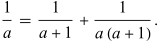
埃及分數幾乎總是需要排除重複項,因為諸如  之類的表示是微不足道的。任何有理數都可以表示為具有任意多項和任意大分母的埃及分數,儘管對於給定固定數量的項,只有有限多個。斐波那契證明了任何分數都可以表示為不同單位分數的和(Hoffman 1998,第 154 頁)。可以使用恆等式構造無限單位分數鏈
 |
(1)
|
Martin (1999) 表明,對於每個正有理數,都存在埃及分數,其最大分母最多為  ,並且其分母構成高達
  的整數的正比例,對於足夠大的
  。每個分數
。每個分數  ,其中
,其中  是奇數,都有一個埃及分數,其中每個分母都是奇數(Breusch 1954;Guy 1994,第 160 頁)。每個
  都有一個
都有一個  項表示,其中
 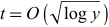 (Vose 1985)。
對於生成具有最小項數或最小可能分母的單位分數表示,尚不清楚任何演算法(Hoffman 1998,第 155 頁)。但是,有許多演算法(包括二進位制餘數法、連分數單位分數演算法、廣義餘數法、貪婪演算法、反向貪婪演算法、小倍數法和分裂演算法)用於將任意分數分解為單位分數。1202 年,斐波那契發表了一種構造單位分數表示的演算法,隨後 Sylvester 重新發現了該演算法(Hoffman 1998,第 154 頁;Martin 1999)。
取分數 1/2、1/3、2/3、1/4、2/4、3/4、...(其分子是 OEIS A002260,其分母是  個整數
個整數  的副本),使用貪婪演算法的單位分數表示為
這些表示中的項數分別為 1、1、2、1、1、2、1、2、2、3、1、... (OEIS A050205)。每個表示的最小分母由 2、3、2、4、2、2、5、3、2、2、6、3、2、... (OEIS A050206) 給出,最大分母為 2、3、6、4、2、4、5、15、10、20、6、3、2、... (OEIS A050210)。
下表總結了使用貪婪演算法的各種常數的埃及分數。
常數  | OEIS |  的埃及分數 的埃及分數 |
 | A006487 | 3, 13, 253, 218201, 61323543802, ... |
 | A118325 | 2, 5, 32, 1249, 5986000, 438522193400489, ... |
 | A069139 | 2,
5, 141, 68575, 32089377154, ... |
 | A006525 | 2, 5, 55, 9999, 3620211523, 25838201785967533906, ... |
 | A006526 | 3,
29, 15786, 513429610, 339840390654894740, ... |
 | A110820 | 2, 13, 3418, 52016149, 153922786652714666, ... |
 | A118323 | 2,
3, 13, 176, 36543, ... |
 | A117116 | 2, 9, 145, 37986, 2345721887, ... |
 | A118324 | 2, 6, 38, 6071, 144715221, ... |
 | A001466 | 8, 61, 5020, 128541455, 162924332716605980, ... |
 | A006524 | 4,
15, 609, 845029, 1010073215739, ... |
任何分母為奇數的分數都可以表示為有限個單位分數的和,每個單位分數的分母都是奇數(Starke 1952,Breusch 1954)。Graham 證明了無限多個在一定範圍內的分數可以表示為分母為平方數的單位分數之和(Hoffman 1998,第 156 頁)。
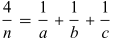
Paul Erdős 和 E. G. Straus 推測丟番圖方程
 |
(12)
|
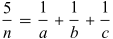
總是可以求解,這一論斷有時被稱為Erdős-Straus 猜想,而 Sierpiński (1956) 推測
 |
(13)
|
可以求解(Guy 1994)。
調和數  永遠不是整數,除了
  。Taeisinger 在 1915 年證明了這個結果,而 Kürschák 在 1918 年證明了更一般的結果,即任何數量的連續項(不一定從 1 開始)的總和永遠不會是整數(Hoffman 1998,第 157 頁)。1932 年,Erdős 證明了任何數量的等距整數的倒數之和永遠不是倒數。
已知一些非平凡的整數集,它們的倒數之和為小整數。例如,存在一個由 366 個正整數(最大值為 992)組成的集合,其倒數之和恰好為 2(Mackenzie 1997;Martin)。已知一個類似的由 453 個小正整陣列成的集合,其總和為 6 (Martin)。
另請參閱
Akhmim 木板,
埃及數學皮革卷軸,
埃及數字,
Engel 展開,
Erdős-Straus 猜想,
調和數,
萊因德紙草書,
單位分數
使用 探索
參考文獻
Beck, A.; Bleicher, M. N.; and Crowe, D. W. Excursions into Mathematics. New York: Worth Publishers, 1970.Beeckmans, L. "The Splitting Algorithm for Egyptian Fractions." J. Number Th. 43, 173-185, 1993.Bleicher, M. N. "A New Algorithm for the Expansion of Continued Fractions." J. Number Th. 4, 342-382, 1972.Breusch, R. "A Special Case of Egyptian Fractions." Solution to advanced problem 4512. Amer. Math. Monthly 61, 200-201, 1954.Eppstein, D. "Ten Algorithms for Egyptian Fractions." Mathematica Educ. Res. 4, 5-15, 1995.Eppstein, D. "Egyptian Fractions." http://www.ics.uci.edu/~eppstein/numth/egypt/. Eppstein, D. Egypt.ma Mathematica 筆記本. http://www.ics.uci.edu/~eppstein/numth/egypt/egypt.ma.Gardner, M. "Mathematical Games: In Which a Mathematical Aesthetic is Applied to Modern Minimal Art." Sci. Amer. 239, 22-32, Nov. 1978.
 Gardner, M. "Babylonian and Egyptian Mathematics, an Egyptian Historical Gap, Installments 1-3." http://www.teleport.com/~ddonahue/phresour.htmlGolomb, S. W. "An Algebraic Algorithm for the Representation Problems of the Ahmes Papyrus." Amer. Math. Monthly 69, 785-786, 1962.Graham, R. "On Finite Sums of Unit Fractions." Proc. London Math. Soc. 14, 193-207, 1964.Guy, R. K. "Egyptian Fractions." §D11 in Unsolved Problems in Number Theory, 2nd ed. New York: Springer-Verlag, pp. 158-166, 1994.Hoffman, P. The Man Who Loved Only Numbers: The Story of Paul Erdős and the Search for Mathematical Truth. New York: Hyperion, pp. 153-157, 1998.Ke, Z. and Sun, Q. "On the Representation of 1 by Unit Fractions." Sichuan Daxue Xuebao 1, 13-29, 1964.Keith, M. "Egyptian Unit Fractions." http://mathpages.com/home/kmath340.htm.Klee, V. and Wagon, S. Old and New Unsolved Problems in Plane Geometry and Number Theory. Washington, DC: Math. Assoc. Amer., pp. 175-177 and 206-208, 1991.Loy, J. "Egyptian Fractions." http://www.jimloy.com/egypt/fraction.htm.Martin, G. "Dense Egyptian Fractions." Trans. Amer. Math. Soc. 351, 3641-3657, 1999.Martin, G. Egyptian fraction summing to 2. http://www.math.ubc.ca/~gerg/papers/downloads/recsum2.pdf.Martin, G. Egyptian fraction summing to 6. http://www.math.ubc.ca/~gerg/papers/downloads/recsum6.pdf.Mackenzie, D. "Fractions to Make an Egyptian Scribe Blanch." Science 278, 224, 1997.MathPages. "Egyptian Unit Fractions." http://www.mathpages.com/home/kmath340.htm.Niven, I. and Zuckerman, H. S. An Introduction to the Theory of Numbers, 5th ed. New York: Wiley, p. 200, 1991.Séroul, R. "Egyptian Fractions." §8.8 in Programming for Mathematicians. Berlin: Springer-Verlag, pp. 181-187, 2000.Sierpiński, W. "Sur les décompositiones de nombres rationelles en fractions primaires." Mathesis 65, 16-32, 1956.Sloane, N. J. A. Sequences A001466/M4553, A002260, A006487/M2962, A006524/M3509, A006525/M1553, A006526/M3122, A050205, A050206, A050210, A069139, A110820, A118323, A118324, and A118325 in "The On-Line Encyclopedia of Integer Sequences."Starke, E. P. "Problem 4512." Amer. Math. Monthly 59, 640, 1952.Stewart, I. "The Riddle of the Vanishing Camel." Sci. Amer. 266, 122-124, June 1992.Tenenbaum, G. and Yokota, H. "Length and Denominators of Egyptian Fractions." J. Number Th. 35, 150-156, 1990.Vose, M. "Egyptian Fractions." Bull. London Math. Soc. 17, 21, 1985.Wagon, S. "Egyptian Fractions." §8.6 in Mathematica in Action. New York: W. H. Freeman, pp. 271-277, 1991.Wells, D. The Penguin Dictionary of Curious and Interesting Numbers. Middlesex, England: Penguin Books, p. 29, 1986.
在 上被引用
埃及分數
請引用為
Weisstein, Eric W. "埃及分數。" 來自 網路資源。 https://mathworld.tw/EgyptianFraction.html
主題分類


